


ΝΕΑ
Πριν μάθουμε στα παιδιά ξένες γλώσσες, ας τους μάθουμε να πιστεύουν στον εαυτό τους.
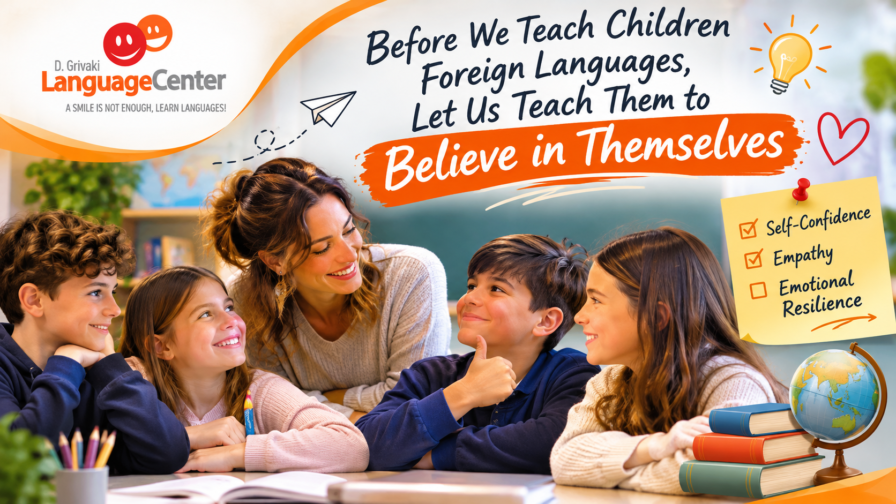
Πριν μάθουμε στα παιδιά ξένες γλώσσες, ας τους μάθουμε να πιστεύουν στον εαυτό τους.
Η αυτοπεποίθηση, η ενσυναίσθηση και η ψυχική ανθεκτικότητα ως θεμέλια της ουσιαστικής εκπαίδευσης.
Άρθρο της Δέσποινας Γριβάκη
Ιδιοκτήτριας & Διευθύντριας Σπουδών του D. Grivaki Language Center
Η εκπαίδευση είναι κάτι πολύ περισσότερο από τη μετάδοση γνώσεων
Στα περισσότερα από είκοσι χρόνια της εκπαιδευτικής μου διαδρομής, έχω συναντήσει εκατοντάδες παιδιά. Παιδιά με διαφορετικές προσωπικότητες, διαφορετικές ικανότητες, διαφορετικά όνειρα, αλλά και διαφορετικούς φόβους. Παιδιά που ξεχώριζαν για τις επιδόσεις τους, αλλά δίσταζαν να εκφραστούν. Παιδιά που δυσκολεύονταν στη μάθηση, αλλά διέθεταν μια αξιοθαύμαστη επιμονή. Παιδιά που είχαν όλες τις δυνατότητες να πετύχουν, αλλά τους έλειπε κάτι θεμελιώδες: η πίστη στον εαυτό τους.
Μέσα από αυτή την πολυετή εμπειρία, έχω καταλήξει σε μια βαθιά πεποίθηση: πριν ζητήσουμε από ένα παιδί να κατακτήσει τη γνώση, οφείλουμε να το βοηθήσουμε να ανακαλύψει την αξία του.
Γιατί η εκπαίδευση δεν είναι απλώς η διδασκαλία μιας ξένης γλώσσας, η απομνημόνευση κανόνων ή η απόκτηση ενός πιστοποιητικού. Είναι μια βαθιά ανθρώπινη διαδικασία, μέσα από την οποία διαμορφώνονται προσωπικότητες, καλλιεργούνται αξίες και χτίζονται τα θεμέλια της μελλοντικής ζωής.
Η αυτοπεποίθηση προηγείται της επιτυχίας
Συχνά, ως γονείς και εκπαιδευτικοί, εστιάζουμε στο αποτέλεσμα. Στον βαθμό του διαγωνίσματος, στην επίδοση, στην επιτυχία των εξετάσεων.
Πόσο συχνά, όμως, αναρωτιόμαστε πώς αισθάνεται το παιδί κατά τη διάρκεια αυτής της προσπάθειας;
Ένας μαθητής μπορεί να γνωρίζει την απάντηση, αλλά να φοβάται να σηκώσει το χέρι του. Μπορεί να έχει μελετήσει συστηματικά, αλλά να κατακλύζεται από άγχος μπροστά σε ένα διαγώνισμα. Μπορεί να διαθέτει εξαιρετικές δυνατότητες, αλλά να συγκρίνει συνεχώς τον εαυτό του με τους συμμαθητές του.
Και εδώ ακριβώς αναδεικνύεται ο ουσιαστικός ρόλος του εκπαιδευτικού.
Να δημιουργήσει τις προϋποθέσεις ώστε το παιδί να αισθανθεί ότι μπορεί να προσπαθήσει χωρίς τον φόβο της αποτυχίας. Να κατανοήσει ότι το λάθος δεν αποτελεί ένδειξη ανικανότητας, αλλά αναπόσπαστο μέρος της μάθησης.
Η αυτοπεποίθηση δεν γεννιέται αποκλειστικά μέσα από τις επιτυχίες. Καλλιεργείται κυρίως μέσα από την αποδοχή, την ενθάρρυνση και την εμπιστοσύνη.
Ένα παιδί που μαθαίνει να πιστεύει στις δυνατότητές του δεν αποκτά απλώς καλύτερη σχέση με τη μάθηση. Αποκτά ένα πολύτιμο εφόδιο για ολόκληρη τη ζωή του.
Η ενσυναίσθηση ως απαραίτητη προϋπόθεση της μάθησης
Ζούμε σε μια εποχή όπου τα παιδιά μεγαλώνουν μέσα σε έναν κόσμο διαρκών αλλαγών, έντονων κοινωνικών επιρροών, ψηφιακής έκθεσης και αυξημένων απαιτήσεων.
Πίσω από κάθε μαθητή, όμως, υπάρχει ένας άνθρωπος με συναισθήματα, ανάγκες και προσωπικές προκλήσεις.
Ο εκπαιδευτικός καλείται να βλέπει πέρα από την επίδοση. Να αναγνωρίζει πότε ένα παιδί χρειάζεται περισσότερη υποστήριξη, πότε μια συμπεριφορά κρύβει ανασφάλεια και πότε η σιωπή αποτελεί έναν έμμεσο τρόπο έκφρασης.
Η ενσυναίσθηση δεν σημαίνει απουσία ορίων ή απαιτήσεων. Σημαίνει ότι αντιμετωπίζουμε κάθε μαθητή με σεβασμό, κατανόηση και δικαιοσύνη.
Σημαίνει ότι δεν συγκρίνουμε τα παιδιά μεταξύ τους, αλλά αναγνωρίζουμε την προσωπική τους πρόοδο.
Σημαίνει ότι επιβραβεύουμε όχι μόνο το άριστο αποτέλεσμα, αλλά και την προσπάθεια, τη συνέπεια, την επιμονή και το θάρρος.
Κυρίως, σημαίνει ότι δημιουργούμε μια τάξη όπου κανένα παιδί δεν αισθάνεται αόρατο.
Η ψυχική ανθεκτικότητα είναι ένα μάθημα ζωής
Στη σύγχρονη εκπαιδευτική πραγματικότητα, η ψυχική ανθεκτικότητα αποκτά ολοένα μεγαλύτερη σημασία.
Δεν μπορούμε να προστατεύσουμε τα παιδιά από κάθε απογοήτευση, κάθε δυσκολία ή κάθε αποτυχία. Μπορούμε, όμως, να τα βοηθήσουμε να αναπτύξουν τις δεξιότητες που χρειάζονται για να διαχειρίζονται αυτές τις εμπειρίες.
Να μάθουν να προσπαθούν ξανά όταν κάτι δεν πηγαίνει όπως το περίμεναν.
Να αντιμετωπίζουν την κριτική χωρίς να αμφισβητούν συνολικά την αξία τους.
Να ζητούν βοήθεια όταν τη χρειάζονται.
Να κατανοούν ότι η πρόοδος δεν είναι πάντοτε γραμμική και ότι η επιτυχία δεν ορίζεται αποκλειστικά από έναν βαθμό.
Η ψυχική ανθεκτικότητα δεν σημαίνει ότι ένα παιδί πρέπει να είναι πάντοτε δυνατό ή να κρύβει τα συναισθήματά του. Σημαίνει ότι μαθαίνει να αναγνωρίζει όσα αισθάνεται, να αναζητά υποστήριξη και να συνεχίζει την προσπάθειά του.
Στόχος μας δεν πρέπει να είναι να μεγαλώσουμε παιδιά που δεν αποτυγχάνουν ποτέ, αλλά παιδιά που δεν φοβούνται να ξαναπροσπαθήσουν.
Ο εκπαιδευτικός ως πρότυπο και συνοδοιπόρος
Η σχέση ανάμεσα στον εκπαιδευτικό και τον μαθητή μπορεί να επηρεάσει καθοριστικά τον τρόπο με τον οποίο ένα παιδί αντιλαμβάνεται τον εαυτό του.
Μια λέξη ενθάρρυνσης, μια πράξη κατανόησης ή η αναγνώριση μιας μικρής προόδου μπορεί να αποκτήσει πολύ μεγαλύτερη σημασία από όση φανταζόμαστε.
Αντίστοιχα, ένας απαξιωτικός χαρακτηρισμός ή μια άδικη σύγκριση μπορεί να αφήσει βαθύ αποτύπωμα στην αυτοεικόνα ενός παιδιού.
Γι' αυτό πιστεύω ότι η διδασκαλία αποτελεί πρωτίστως πράξη ευθύνης.
Ο καλός εκπαιδευτικός δεν είναι εκείνος που απλώς γνωρίζει άριστα το αντικείμενό του. Είναι εκείνος που μπορεί να μεταδώσει τη γνώση με τρόπο που να εμπνέει, να κινητοποιεί και να ενδυναμώνει.
Είναι εκείνος που θέτει υψηλούς αλλά ρεαλιστικούς στόχους, που επιμένει χωρίς να αποθαρρύνει και που αναγνωρίζει ότι κάθε παιδί έχει τον δικό του ρυθμό εξέλιξης.
Και πάνω απ' όλα, είναι εκείνος που δεν ξεχνά ότι απέναντί του δεν βρίσκεται απλώς ένας μαθητής, αλλά μια προσωπικότητα που διαμορφώνεται.
Η εκμάθηση ξένων γλωσσών ως δρόμος προς την αυτοέκφραση
Στον χώρο της ξενόγλωσσης εκπαίδευσης, αυτή η φιλοσοφία αποκτά ιδιαίτερη σημασία.
Μια ξένη γλώσσα δεν είναι απλώς ένα σύνολο γραμματικών κανόνων και λεξιλογικών δομών. Είναι ένα εργαλείο επικοινωνίας, σύνδεσης με διαφορετικούς πολιτισμούς και διεύρυνσης των προσωπικών οριζόντων.
Όταν ένα παιδί καταφέρνει να εκφράσει τη σκέψη του σε μια άλλη γλώσσα, δεν κατακτά μόνο μια γλωσσική δεξιότητα. Κάνει ένα βήμα προς την αυτονομία και την αυτοπεποίθηση.
Όταν συμμετέχει σε μια συζήτηση, συνεργάζεται με τους συμμαθητές του ή παρουσιάζει μια εργασία, μαθαίνει να εκφράζει την άποψή του, να ακούει τους άλλους και να σέβεται τη διαφορετικότητα.
Όταν ξεπερνά τον φόβο του λάθους και τολμά να μιλήσει, κατακτά κάτι πολύ σημαντικότερο από τη σωστή προφορά μιας λέξης: κατακτά το θάρρος της έκφρασης.
Αυτός είναι, κατά την άποψή μου, ένας από τους σημαντικότερους στόχους της σύγχρονης ξενόγλωσσης εκπαίδευσης.
Η συνεργασία οικογένειας και σχολείου
Καμία εκπαιδευτική προσπάθεια δεν μπορεί να είναι ολοκληρωμένη χωρίς την ουσιαστική συνεργασία οικογένειας και σχολείου.
Τα παιδιά χρειάζονται ένα κοινό πλαίσιο αξιών, μέσα στο οποίο η προσπάθεια αναγνωρίζεται, τα λάθη αντιμετωπίζονται με κατανόηση και η προσωπική τους αξία δεν εξαρτάται από τις επιδόσεις τους.
Χρειάζονται γονείς που να τα ακούν πραγματικά και εκπαιδευτικούς που να τα αντιμετωπίζουν με σεβασμό.
Χρειάζονται ενθάρρυνση, αλλά και όρια. Ελευθερία έκφρασης, αλλά και υπευθυνότητα. Υψηλές προσδοκίες, αλλά όχι εξουθενωτική πίεση.
Πάνω απ' όλα, χρειάζονται ενήλικες που να συνεργάζονται, αντί να μεταφέρουν ο ένας στον άλλον την ευθύνη της διαπαιδαγώγησης.
Γιατί η εκπαίδευση είναι μια συλλογική προσπάθεια και η συναισθηματική ανάπτυξη των παιδιών αποτελεί κοινή μας ευθύνη.
Το μεγαλύτερο επίτευγμα ενός σχολείου
Καθώς ο Νοέμβριος μάς δίνει μια ακόμη ευκαιρία να προβληματιστούμε για τον σχολικό εκφοβισμό, την αποδοχή της διαφορετικότητας και την ψυχική ευημερία των παιδιών, θεωρώ σημαντικό να επαναπροσδιορίσουμε τις εκπαιδευτικές μας προτεραιότητες.
Η πρόληψη του σχολικού εκφοβισμού δεν περιορίζεται σε ενημερωτικές δράσεις και περιστασιακές παρεμβάσεις. Ξεκινά από την καθημερινή κουλτούρα ενός σχολείου: από τον τρόπο που μιλάμε στα παιδιά, από τον τρόπο που διαχειριζόμαστε τις συγκρούσεις και από τον σεβασμό που δείχνουμε στη μοναδικότητα κάθε μαθητή.
Ένα πραγματικά επιτυχημένο σχολείο δεν μετρά την αξία του μόνο μέσα από τα ποσοστά επιτυχίας στις εξετάσεις.
Τη μετρά και μέσα από τα παιδιά που απέκτησαν αυτοπεποίθηση.
Μέσα από τους μαθητές που έμαθαν να συνεργάζονται, να σέβονται και να αποδέχονται.
Μέσα από εκείνους που ξεπέρασαν έναν φόβο, ανακάλυψαν μια ικανότητα ή τόλμησαν να πιστέψουν περισσότερο στον εαυτό τους.
Ως εκπαιδευτικός και Διευθύντρια Σπουδών, εξακολουθώ να πιστεύω ότι η μεγαλύτερη επιτυχία μας δεν είναι μόνο να βλέπουμε τους μαθητές μας να αποκτούν αναγνωρισμένα πιστοποιητικά γλωσσομάθειας, αλλά να τους βλέπουμε να εξελίσσονται σε ανθρώπους με αυτοπεποίθηση, ενσυναίσθηση, κριτική σκέψη και σεβασμό προς τον συνάνθρωπο.
Γιατί, στο τέλος της ημέρας, οι γνώσεις που προσφέρουμε στα παιδιά είναι πολύτιμες. Η πίστη, όμως, που τα βοηθάμε να αποκτήσουν στον εαυτό τους μπορεί να τα συνοδεύει σε ολόκληρη τη ζωή τους.
Και ίσως αυτή να είναι η σημαντικότερη αποστολή της εκπαίδευσης.
Δέσποινα Γριβάκη
Ιδιοκτήτρια & Διευθύντρια Σπουδών
D. Grivaki Language Center
Ηράκλειο Κρήτης
Νοέμβριος 2026
Before We Teach Children Foreign Languages, Let Us Teach Them to Believe in Themselves
Self-confidence, empathy, and emotional resilience as the foundations of meaningful education.
By Despoina Grivaki
Founder, Owner & Director of Studies, D. Grivaki Language Center
Education Is About Much More Than Imparting Knowledge
Throughout my more than twenty years in education, I have had the privilege of meeting hundreds of children. Children with different personalities, abilities, dreams, and fears. Children who excelled academically but hesitated to express themselves. Children who struggled with learning but demonstrated remarkable determination. Children who possessed every potential to succeed but lacked something fundamental: belief in themselves.
Over the years, these experiences have reinforced one of my deepest convictions: before we ask children to acquire knowledge, we must help them recognise their own worth.
Education is not simply about teaching a foreign language, memorising grammatical rules, or obtaining an internationally recognised certificate. It is a profoundly human process through which personalities are shaped, values are cultivated, and the foundations for future life are established.
Self-Confidence Comes Before Success
As parents and educators, we often focus on results: examination grades, academic performance, and measurable achievements.
But how often do we stop to consider how a child feels throughout the learning process?
A student may know the correct answer but be afraid to raise their hand. Another may have studied diligently but feel overwhelmed by anxiety before an examination. A child may possess exceptional abilities yet constantly compare themselves with their classmates.
This is precisely where the true responsibility of an educator becomes evident.
Our role is to create an environment in which children feel confident enough to try without fearing failure. We must help them understand that making mistakes is not a sign of inadequacy but an essential part of learning.
Self-confidence is not built solely through success. It develops through acceptance, encouragement, and trust.
A child who learns to believe in their abilities does not simply develop a healthier relationship with education. They acquire an invaluable resource that can accompany them throughout their entire life.
Empathy: The Heart of Meaningful Education
We live in an era in which children are growing up amid constant change, intense social influences, digital exposure, and increasing expectations.
Yet behind every student stands an individual with emotions, needs, insecurities, and personal challenges.
An educator must learn to look beyond academic performance.
We must recognise when a child needs additional support, when certain behaviours may reflect insecurity, and when silence itself may be an indirect expression of distress.
Empathy does not mean abandoning boundaries or lowering expectations. It means approaching every student with respect, understanding, and fairness.
It means recognising individual progress rather than constantly comparing children with one another.
It means celebrating not only outstanding results but also effort, consistency, perseverance, and courage.
Above all, it means creating a classroom in which no child feels invisible.
An emotionally supportive learning environment does not eliminate academic challenges. Instead, it gives children the confidence and security they need to face those challenges.
Emotional Resilience: A Lesson for Life
In today's educational landscape, emotional resilience has become increasingly important.
We cannot protect children from every disappointment, difficulty, or failure. We can, however, help them develop the skills necessary to navigate these experiences constructively.
We can teach them to try again when things do not go according to plan.
To accept constructive criticism without questioning their entire sense of self-worth.
To seek support when they need it.
To understand that progress is not always linear and that success cannot be measured exclusively through grades.
Emotional resilience does not mean expecting children to remain strong at all times or suppress their feelings. It means helping them acknowledge their emotions, develop healthy coping strategies, and approach challenges with determination.
Our goal should not be to raise children who never fail, but children who are not afraid to try again.
This distinction is fundamental.
A child who views failure as a permanent judgement may eventually stop taking risks. A child who understands failure as an opportunity for growth is more likely to develop perseverance, independence, and confidence.
These qualities extend far beyond the classroom.
The Teacher as a Role Model, Mentor, and Source of Inspiration
The relationship between teacher and student can profoundly influence the way a child perceives themselves.
A simple word of encouragement, a moment of understanding, or the recognition of a small achievement can have a far greater impact than we might imagine.
Equally, an unfair comparison, a dismissive comment, or a humiliating experience can negatively affect a child's self-image.
For this reason, I have always believed that teaching is, above all, an act of responsibility.
An exceptional educator is not simply someone who possesses extensive subject knowledge.
It is someone who can communicate that knowledge in a way that inspires, motivates, and empowers.
Someone who establishes high yet realistic expectations, encourages persistence without creating fear, and recognises that every child develops at their own pace.
Most importantly, an educator must never forget that the individual sitting in front of them is not merely a student preparing for an examination, but a developing personality whose future is being shaped.
Great teachers do more than prepare students for examinations. They prepare them for life.
Foreign Language Learning as a Pathway to Self-Expression
Within foreign language education, this philosophy becomes particularly meaningful.
A foreign language is not simply a collection of grammatical structures and vocabulary. It is a powerful instrument of communication, cultural understanding, personal development, and connection with the wider world.
When a child learns to express their thoughts in another language, they achieve far more than linguistic competence.
They take an important step towards independence and self-confidence.
When students participate in discussions, collaborate with classmates, or deliver presentations, they learn to articulate their opinions, listen actively, and respect different perspectives.
When they overcome their fear of making mistakes and find the courage to speak, they achieve something far more significant than perfect pronunciation.
They discover the confidence to make their voices heard.
In my view, this is one of the most valuable outcomes of modern foreign language education.
Language learning should empower children to communicate confidently, think critically, embrace diversity, and engage meaningfully with the world around them.
An internationally recognised language qualification is undoubtedly an important achievement. However, the personal growth that accompanies the learning journey can be equally valuable.
The Essential Partnership Between Families and Schools
No educational approach can reach its full potential without meaningful cooperation between families and schools.
Children need consistency in the values communicated by the adults around them.
They need to grow up in environments where effort is acknowledged, mistakes are treated as opportunities for improvement, and personal worth is never determined solely by academic performance.
They need parents who genuinely listen and teachers who treat them with dignity and respect.
They need encouragement alongside clear boundaries, freedom of expression alongside responsibility, and high expectations without overwhelming pressure.
Above all, they need adults who work together rather than shift responsibility from one another.
Education is a shared commitment, and supporting children's emotional development is a collective responsibility.
When schools and families communicate openly and constructively, children benefit from a stronger sense of stability, belonging, and emotional security.
What Truly Defines a Successful School?
As November provides another opportunity to reflect on school bullying, acceptance, inclusion, and children's emotional well-being, I believe it is important to reconsider what we truly value in education.
Preventing bullying cannot be limited to occasional awareness campaigns or isolated interventions.
It begins with the everyday culture of a school.
With the way we speak to children.
With the way we respond to differences.
With the way we resolve conflicts.
With the respect we demonstrate towards every individual, regardless of their abilities, background, or personal circumstances.
A genuinely successful educational institution should not measure its value exclusively through examination results or academic distinctions.
It should also recognise the children who have gained confidence.
The students who have learned to collaborate, show empathy, and embrace diversity.
Those who have overcome personal fears, discovered hidden abilities, or finally found the courage to believe in themselves.
As an educator and Director of Studies, I continue to believe that our greatest achievement is not simply seeing our students obtain internationally recognised language qualifications.
It is witnessing their development into confident, compassionate, resilient individuals who possess critical thinking skills, respect for others, and a genuine desire to continue learning.
A Final Thought
Education has the power to transform lives, but its influence extends far beyond textbooks, classrooms, and examinations.
Every interaction between an educator and a child presents an opportunity to strengthen confidence, encourage curiosity, nurture empathy, and inspire personal growth.
The knowledge we provide is undeniably valuable.
The qualifications our students obtain may open doors to universities, careers, and international opportunities.
But the belief we help them develop in themselves may remain with them long after they have forgotten individual lessons or examination results.
Before we teach children how to speak another language, let us make sure they feel confident enough to use their own voice.
Before we teach them how to succeed, let us teach them that failure does not define them.
And before we prepare them for examinations, let us remember that our greatest responsibility is to help prepare them for life.
Because ultimately, the most meaningful achievement of education is not simply what children learn.
It is who they become.
Despoina Grivaki
Founder, Owner & Director of Studies
D. Grivaki Language Center
Heraklion, Crete, Greece